
Gutkha and Paan Masala: What It Does to Your Mouth, and What Doesn't Come Back
3 November 2026
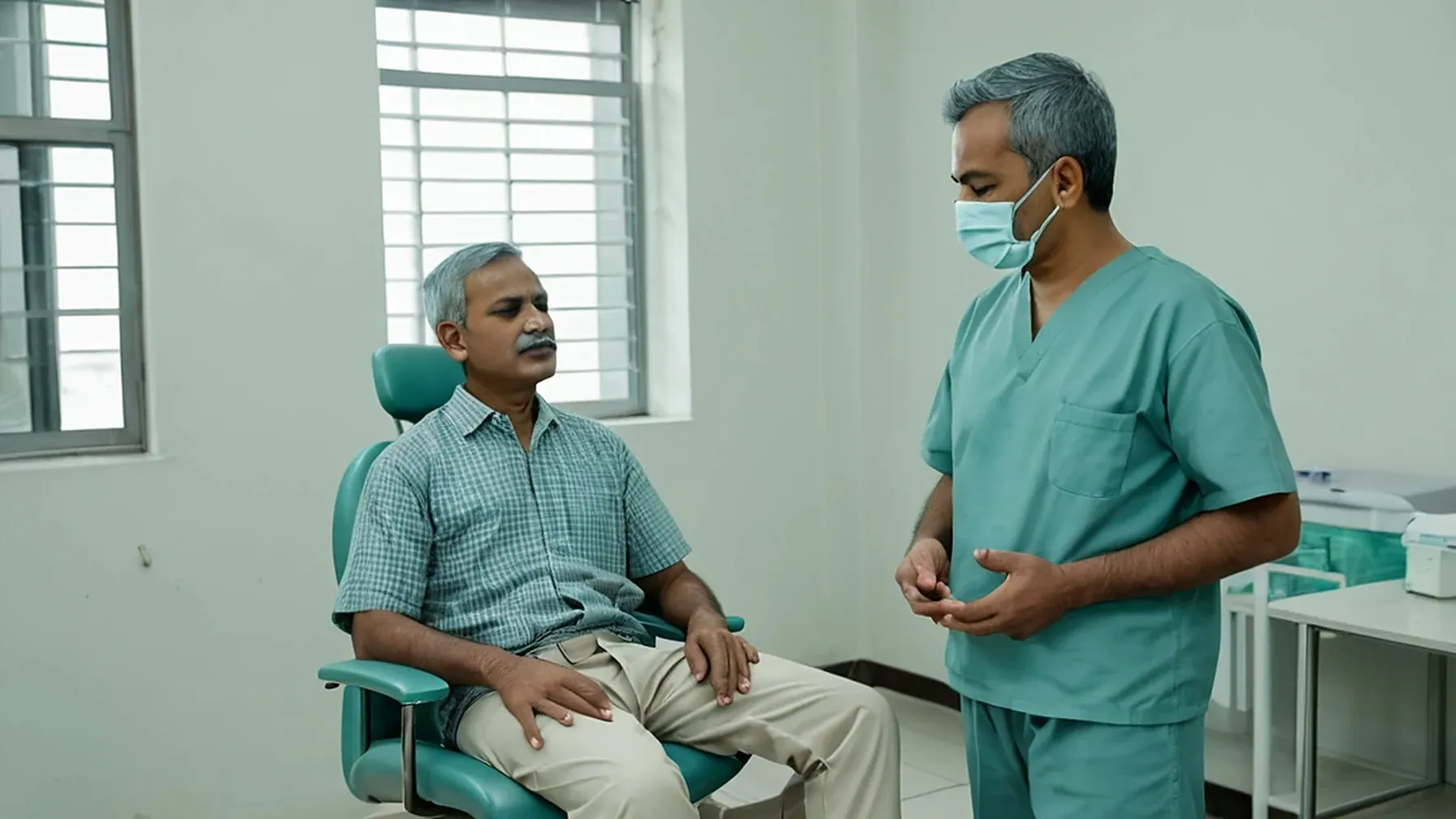
The short answer. Gutkha and paan masala damage the mouth in three places: they stain and wear the teeth, they destroy the gum where the quid sits, and they change the lining itself. Some of that returns when you stop. The gum and the scarring do not.
General information, not a diagnosis. A white patch has to be examined in person.
What Does Gutkha Do to Your Mouth?
Most people hold the quid in the same spot, low in the cheek against the gum, several times a day for years. That is why the damage is easy to find: it sits where the quid sits.
The grit abrades and the lime burns, so the gum pulls back and does not return. Long-term chewers often end up with a notch of exposed root and heavy staining there.
The lining goes greyish white and wrinkled at the contact site — tobacco pouch keratosis, the earliest visible change. Over time it can harden into a white or red patch. The ICMR review reports buccal involvement in as many as 80% of cancers arising where the quid is placed.
What Is Actually in Gutkha?
Chewing tobacco, areca nut, slaked lime, catechu and spices, usually sweetened.
Tobacco brings nicotine and tobacco-specific nitrosamines; the US National Cancer Institute counts at least 28 cancer-causing chemicals in smokeless tobacco.
Areca nut (supari) is the part people underestimate. In 2003 the WHO's cancer agency concluded that areca nut is carcinogenic to humans (IARC Group 1), and that betel quid without tobacco is carcinogenic too. The ICMR review is blunter: oral submucous fibrosis is "solely caused by areca nut", and the literature has wrongly pinned it on smokeless tobacco.
A survey of 402,669 people in Lucknow found oral precancer in 3.17% of pan masala users who did not use tobacco, against 0.16% of non-users: an odds ratio of 20.7 (Mehrotra et al., 2017).
Slaked lime (chuna) is not filler. It makes the mouth alkaline; above pH 9.5 the cited work reports reactive oxygen species and irritation of the lining into thickening.
Moving from gutkha to plain supari is a change of packaging, not a reduction in risk.
Is Gutkha Worse Than Smoking?
"Worse" is the wrong question, and anyone answering with a flat yes or no is selling something.
Smokeless tobacco is not a safe substitute for cigarettes, per the National Cancer Institute. What differs is where the damage lands. Smoke travels the whole upper airway. A quid sits still, so chewing tends to produce cancers at the contact site.
A meta-analysis of ten studies put the relative risk for betel quid with tobacco at 6.19 (95% CI 4.16–9.21).
What Are the White Patches in the Mouth From Tobacco?
Leukoplakia is a description rather than a diagnosis: a white patch that cannot be rubbed or scraped off. The NHS describes patches that are not usually painful, irregular in shape, sometimes raised, sometimes with red areas inside, often on or under the tongue or inside the cheek.
Leukoplakia is around six times more common in smokeless tobacco users. The patch is not the danger; what sits under it is. Some patches carry dysplasia, cell change that can precede cancer, and you cannot see that by looking. A red area inside a white patch raises the concern.
The NHS wording is exact: "there's a small chance it could progress to mouth cancer over time". A painless patch is the trap, which is why one that does not go away should be seen.
Three weeks is the line. A patch or ulcer sitting in one place beyond that is the appointment to make. Our notes on ulcers that will not heal explain why.
Does Chewing Tobacco Cause Gum Disease?
Yes. The ICMR review lists gum recession with exposed roots, periodontal pockets and plaque among smokeless tobacco users, with odds ratios for periodontal inflammation between 1.6 and 3.6.
In a Delhi NCR study of 100 gutkha chewers and 100 non-chewers, recession was present in 62% against 25%, and attachment loss over 5mm in 41% against 21%.
Two mechanisms: an abrasive, alkaline bolus held against thin gum for hours, and arecoline from areca nut, which affects the fibroblasts holding a tooth in its socket. Both act where the quid sits, which is why a dentist asks which side you chew on.
Gum treatment can control inflammation. It cannot rebuild what has gone.
What Reverses, and What Doesn't
| What changed | Does it reverse? |
|---|---|
| Staining | Mostly, with professional cleaning, once the habit stops. |
| Gum inflammation, bleeding | Largely, over weeks, with cleaning. |
| Early white patch in a young mouth | Often. |
| Gum recession | No. Gum does not grow back. |
| Oral submucous fibrosis | Not usually. Care is about stopping progression. |
| Long-standing patch, or dysplasia | Cannot be assumed to reverse. Needs review. |
A cohort of 12,212 tobacco users in Kerala, examined annually for ten years, found new leukoplakia dropped sharply among those who stopped, incidence ratio 0.31. That is fewer new lesions, not a guaranteed drop in cancer risk.
The better-known study examined 3,051 US Air Force trainees at the start of basic training, mean age 19.5. Among smokeless tobacco users, 39.4% had leukoplakia, against 1.5% of non-users. After six weeks of mandatory abstinence, 97.5% of those lesions had resolved clinically.
Read the caveat first. Those were young, otherwise healthy men in a compulsorily tobacco-free environment, examined twice in six weeks. Applying 97.5% to a 50-year-old with a twenty-year habit is not what the study found.
Fibrosis is the other side. Oral submucous fibrosis is scarring of the lining that tightens the mouth, and the tightness on opening wide usually does not return, which is why care aims at stopping it getting worse.
What Does a Mouth Cancer Screening Involve?
About ten minutes, and most of it is looking: both cheeks, gums, under the tongue, the floor of the mouth, the back of the throat.
Then the hands. A gloved finger feels for anything firm or fixed, and the neck and jaw are checked for enlarged nodes. No fasting, no dye, no pain.
If something needs a closer look, you are referred and usually biopsied. The NHS says results usually come back within two weeks. A dentist cannot rule cancer in or out by eye, and should not claim to.
What happens if something is found?
Nobody can promise a cure, and anyone who does is not being straight with you.
Per the NHS, surgery is usually needed and can mean removing part of the tongue or jaw. Radiotherapy may be the only treatment needed if the cancer is found early. For advanced cancer, treatment may not cure, and the aim shifts to slowing growth and easing symptoms.
Same disease, same guidance. The difference is largely when it was found. Not that early means safe. That early means smaller.
Screening and referral are what this clinic does. Cancer treatment is not; that belongs with an oncology team, and we will say so plainly if that is where you need to be. The screening itself is part of a routine examination, done by our dentists.
Quitting: What Changes in Your Mouth, and When
First two weeks. Nothing looks different yet, and you may feel worse before better. Nicotine withdrawal is real and temporary. The National Tobacco Quitline is free on 1800-11-2356. It is counselling, not medicine; anything medicinal belongs with a clinician who knows your history.
Week two to six. Staining stops getting worse; what is already there can be cleaned off.
Around six weeks. Early white patches have a real chance of fading. If yours has not changed by then, that is information, not a failure.
Two notes. Cutting down is not the same as stopping. And stopping does not undo fibrosis or bring back receded gum; it stops the clock on the parts still moving.
If You Have Been Putting This Off
A white patch or a receding gum is not an emergency. It is easier at ten minutes than at two years.
A check-up at 222 Model Town, Sonipat takes about half an hour. Mon–Sat 9am–2pm and 4:30–7:30pm, Sun 9am–2pm. Call +91 72067 22618, or book a check-up. Our page on dental treatment costs in Sonipat covers consultation fees.
No lectures at the door.
Book Your Visit
Fill out the form below and we will contact you immediately.
FAQ
Frequently Asked Questions
01Does gutkha cause cancer even if you spit out the juice?
Yes. Spitting removes the excess, not the exposure. The carcinogens sit against the lining while the quid is in place, and some is swallowed.
02Is tobacco-free paan masala safe?
No. IARC lists areca nut as a Group 1 carcinogen in its own right, independent of tobacco, and pan masala is built on areca nut and slaked lime. Removing tobacco removes one hazard, not the hazard.
03Can a white patch in the mouth go away on its own?
Sometimes, especially in younger people with a short history, and more reliably once the habit stops. But nobody can tell by looking which patch will fade and which carries dysplasia.
04How long after quitting does mouth cancer risk actually fall?
There is no honest single number. New leukoplakia becomes much less common after stopping, roughly a third of the previous rate in one Indian cohort. Beyond that, it depends on how long and how much you used.
05Is it too late to stop after twenty years?
No. Some damage is permanent, but the parts still moving stop moving. That is worth having. <small><strong>General information only.</strong> This article does not diagnose, does not replace an examination, and cannot tell you what a particular patch is. This clinic provides oral cancer screening and referral, not cancer treatment. If you are worried about a white patch, an ulcer or a receding gum, have it looked at in person. Sources: <a href="https://www.who.int/news/item/07-08-2003-iarc-monographs-programme-finds-betel-quid-and-areca-nut-chewing-carcinogenic-to-humans" rel="nofollow noopener" target="_blank">WHO/IARC</a>, <a href="https://ijmr.org.in/oral-health-consequences-of-smokeless-tobacco-use/" rel="nofollow noopener" target="_blank">IJMR/ICMR</a>, <a href="https://www.cancer.gov/about-cancer/causes-prevention/risk/tobacco/smokeless-fact-sheet" rel="nofollow noopener" target="_blank">NCI</a>, <a href="https://www.nhs.uk/conditions/leukoplakia/" rel="nofollow noopener" target="_blank">NHS leukoplakia</a> and <a href="https://www.nhs.uk/conditions/mouth-cancer/treatment/" rel="nofollow noopener" target="_blank">NHS mouth cancer treatment</a>. Published 3 November 2026 by Mukhija Dental & ENT Centre, 222 Model Town, Sonipat 131001. Reviewed by Dr. Bhupesh Mukhija, BDS, MDS.</small>